Monday, November 29, 2010

Chilean Copper Cookware

For my birthday I received this handsome copper paila from my step daughters and their husbands (Thank you again, M, M, J & N.).  Aside from its beauty, I knew that copper was one of the best cookware materials because of its rapid and even heating.  But I also knew there were some problems in cooking in copper… but exactly what they were, I didn’t know.

  
As I began to search the internet, I quickly discovered that most copper cookware is coated with another metal because copper oxidizes when in contact with acids, creating the greenish patina seen on old copper, bronze and brass.  This patina, called verdigris, is toxic and can cause gastrointestinal problems if ingested. 

Traditionally copper was lined with a thin coating of tin, but tin scratches and will wear away in time.  Tin also melts at only 425° F, a temperature easily reached in cooking.  Nickel is also used as a lining, but the most common lining today is stainless steel.

My paila seems to be unlined.  There is no obvious lining, the color is the same inside and out, and ArteCobre, the major seller of Chilean copper cookware (and presumably of mine), makes no mention of lining.  Not a good sign, as one of the first copper cookware sites I encountered had this warning:


 The information sheet which came with my paila said the following:

Cooking with pots or utensils of copper
 Copper has been commonly used in pots and kitchen utensils, it is very easy to work but it has its problems. What are the advantages and disadvantages of cooking in copper pots and utensils? (All translations mine unless otherwise noted.)

The advantages listed were:  copper’s even heating and rapid conductivity of heat, the reduced tendency of food to stick because of the uniform temperature of the cooking surface, copper’s antibacterial properties, that vegetables like asparagus and artichokes cooked in copper retain their bright green color, and that jams and jellies cooked in copper are delicious and maintain a brilliant color.  The final advantage is that

Poisoning from cooking in copper does not occur easily [La intoxicación cocinando con cobre es muy difícil] because the pot or utensil lets us know we should not use it through its green patina, and in addition, food cooked in it would have a strong flavor that would keep us from eating it.  By contrast, we are being poisoned slowly without realizing it from tasteless traces of lead or asbestos   in foods cooked in utensils of aluminum.  We only have to keep copper utensils clean and unstained [to avoid problems].[1]

When I searched the internet for the wording of ArteCoblre’s information sheet, I found it at En Buenas Manos, a site providing information on “Beauty, Ecology, Illness, Esoterica, Pets, Nutrition, Recipies, Reflections, Therapies, and Healthy Life.”  The author was Josep Vicent Arnau, Naturopath and Acupuncturist.

There is a certain attractive logic to the idea that cooking in unlined copper is safe if you keep the copper clean and don’t eat anything cooked in it that tastes bad.   And the articles I read on En Buenas Manos’ web site were sane, reasonable and not just marketing quackery, but Mr. Arnau’s credentials didn’t instill a great deal of confidence. (See Wikipedia’s article on Naturopathy and judge for yourself.) 

Surely there is more authoritative advice. 

And, of course, there is.  I. Herbert Scheinberg, M.D., (1920-2009) professor of medicine at the Albert Einstein College of Medicine, was one of the nation’s experts on copper toxicity and Wilson’s disease, a genetic disorder causing the toxic accumulation of dietary copper in the liver, brain and other organs. According to one of the best articles I found, “The Importance of Copper Cookware for Cooking” from the site Retinning and Copper Care:

[Dr. Scheinberg] contends that unless the copper has oxidized extensively enough to produce the green-blue copper salts commonly known as "verdigris," and/or highly acidic foods are to be cooked in the pot [with scratched or worn lining], use of the vessel is not dangerous. If acidic foods come in contact with the copper, they'll dissolve and absorb the copper salts, which are toxic. If the salts are present, the pot should be scoured. 
 [He says ] "Yes, people can get gastrointestinal upsets. But contrary to popular belief it's not fatal."

 The US Food and Drug Administration also has something to say about cooking in unlined copper pans:

John Thomas, of the division of regulatory guidance at the FDA’s Center for Food Safety and Applied Nutrition says that the agency cautions against using unlined copper for general cooking because the metal is relatively easily dissolved by some foods with which it comes in contact and, in sufficient quantities, can cause nausea, vomiting and diarrhea.[2]

So where are we?  At one extreme we have The Copper Shop’s “NEVER COOK WITH AN UNLINED COPPER POT,” and at the other, ArteCobre’s “Poisoning from cooking in copper does not occur easily. “  Somewhere in the middle the FDA “cautions against using unlined copper for general cooking” and Dr.  Scheinberg says, “unless the copper has oxidized extensively … and/or highly acidic foods are to be cooked, …use of the vessel is not dangerous.”

At this point it is obvious that my paila is not going to be my everyday pot.  Egg whites and whipped cream are said to have more volume when beaten in unlined copper bowls, but what can be safely cooked in unlined pans? 

Unlined copper vessels are produced especially for making sugar syrups and candies:

A sugar pot or sugar boiler is an unlined copper pan that is used, primarily by pastry chefs, to make sugar syrups. Because copper is so responsive to the heat, the pan gives the chef instant control as he or she boils the syrup to just the right temperature.
The acidity of the unlined copper causes some of the sugar to "invert," or split into glucose and fructose, which helps resist the sugar's tendency to recrystallize. The pans are also unlined because a traditional tin lining would come too close to melting temperatures in some cases….[3]
They are also used to make jams and jellies, as in the Mauviel jam pan below, where it seems that the high sugar content offers some protection against the acids contained in the fruit… how and why, I could not discover.


And they are used for making polenta:


What they are clearly not used for is cooking acidic foods; no tomato sauce, meats braised in wine, or sausages with sauerkraut.  But it seems to me that, if used with caution, and cooked in sparkling clean pans, foods that are low in acid should be safe.  (But note I am an anthropologist, not a chemist, toxicologist, MD or anything close to being pertinent to this issue… this is not a recommendation for others.)


So what are low acid or non acidic foods?  Here are some examples of foods that occur frequently in my cooking[4] (For reference pH 7.0 is neutral; above 7.0 is alkaline; and below 7.0 is acidic; orange juice is 3.3 – 4.2)
 
It looks like green olives and tomatoes will definitely be excluded from my piala. Wine too, with an average pH of 3.3 to 3.7.[5]  But most everything else looks OK, especially if the bulk of a dish is a food that is close to neutral, like rice.


What did I cook?  Paella. 


Here’s my paella recipe.  Average pH of ingredients: around 6.0 – 6.2.  Serves 4.

Olive oil as needed
1 medium onion, chopped
1 - 2 cloves garlic, minced
½ green bell pepper
½ red bell pepper
3 chicken thighs, boned (bones reserved)
2 smoked sausages, 4-5” long
2 lbs. mussels
1 lb.clams (mine were very small, more ornamental than substantive)
1 ½ cups short grain rice
Thyme, paprika (AKA ají de color), saffron (if you have it, I didn’t)
1 cup green beans or peas (frozen/pre-cooked)
½ cup black olives
Minced parsley

Clean mussels and clams, discarding any broken ones and those that don’t close.  Reserve a dozen or so mussels, and steam the rest for 3-5 minutes in a cup of water until they open. Remove the meat from the open mussels and save the broth.  Add 2 - 3 cups water and the chicken bones to the mussel broth (+ onion trimmings, parsley stems, etc.) and simmer until needed. 

Heat copper paila over a low flame until moderately hot (be careful, this won’t take long) add olive oil, chicken and sausages and sauté over low heat until brown.  Remove meats and sauté onion, adding garlic and bell peppers after a few minutes. Then add thyme, paprika and saffron. Return meats to paila and add the rice.  Sauté rice for 2-3 minutes, then add 3 cups mussel/chicken broth.  Raise heat until the broth boils, then lower to a simmer.  Cook without a lid for 15 to 20 minutes, tasting the rice for doneness from time to time (it should be al dente) and adding additional boiling broth if necessary.  When about ½ the broth has been absorbed, add the reserved mussel meat and green beans or peas and stir.  Then add the clams and mussels by pushing them into the rice. When rice is done, add olives and parsley, turn off the flame, cover paila with a lid, dish towels, etc. and allow to rest for 5 to 10 minutes.
 
Serve with lemon quarters, salad and wine.

*********

It was great, with no off taste and (obviously) no greenish tint.  And we felt fine afterwards… and still do. 

I’m not going to use my paila every day, but I’ll make this paella again, and use it for polenta and risotto and jam.  Maybe I’ll even make fudge.


[1] Handout, ArteCobre.  The text appears at En Buenos Manos, on line at http://www.enbuenasmanos.com/articulos/muestra.asp?art=125.
[2] Blumenthal, Dale (1990). Is That Newfangled Cookware Safe? DHHS Publication No. (FDA) 91-2242. On line at
[3] How to Make a Sugar Syrup in a Sugar Pot (or Not). O Chef. On line at http://www.ochef.com/735.htm
[4] Master List of Typical pH and Acid Content of Fruits and Vegetables for Home Canning and Preserving.  On line at http://www.pickyourown.org/food_acidity_ph_list.htm, and Measuring the pH Value of Meat. Eutech instruments.  On line at http://www.eutechinst.com/techtips/tech-tips35.htm  Beef reaches its lowest pH 18 to 24 hours after slaughter, after which it rises again.
[5] Pandell, Alexander J. 1999. The Acidity Of Wine.  On line at http://www.wineperspective.com/the_acidity_of_wine.htm

Monday, November 22, 2010

Breaded Whale Cutlets?

Thumbing through my wife’s classic Chilean cookbook, La Gran Cocina Chilena [1], I came across this recipe in the fish and seafood section:

Breaded Whale Cutlets  (Escalopas de Ballena)

1 kg. whale
2 teaspoons  vinegar
2 eggs
¼ lt. of oil
¼ kg. bread crumbs
Salt, pepper, parsley

Cut the meat into thin cutlets, and soak in vinegar water for approximately 48 hours. Then season with salt, pepper and parsley.  Beat the eggs and pass the cutlets through the beaten egg and then through the bread crumbs.  Heat the oil in a skillet and fry the cutlets. (All translations mine unless otherwise noted)

Aside from confirming my suspicion that the 2000 edition had not received much editing from previous editions (Chile stopped commercial whale hunting in 1983[2]), it made me curious—and cost me several weeks of research.

Was whale once important in Chilean diet?

Well, yes        ...and no.

Except for a brief and evidently unsuccessful marketing campaign to bring whale meat to the urban population in the 60s, whale meat was important only to indigenous Chileans.  Whale oil, on the other hand, was a major ingredient in Chilean margarine for many years.

Whales in Aboriginal Diet

On the coast of Chilean Patagonia, like other coasts where whales and humans existed, a beached whale, with it’s tons of meat and fat, was a gift not to be refused.  The Chilean coast, from the Island of Chiloe south to Tierra del Fuego, was the home of maritime hunter-gathers, the Yaghan, Kawésqar, and Chono[3]  “Canoe Indians.”  They lived on an almost exclusively meat diet, and traveled long distances trough the channels of the southern archipelago in bark canoes warmed by fires built on sod platforms. The men hunted seals and the women dove for shellfish in the frigid water.  They had no clothing other than seal skin capes.  Darwin, like most other Europeans, reacted to them with a mixture of pity and horror:

While going one day on shore near Wollaston Island, we pulled alongside a canoe with six Fuegians. These were the most abject and miserable creatures I anywhere beheld. ….these Fuegians in the canoe were quite naked, and even one full-grown woman was absolutely so. …These poor wretches were stunted in their growth, their hideous faces bedaubed with white paint, their skins filthy and greasy, their hair entangled, their voices discordant, and their gestures violent.  ….Whenever it is low water, winter or summer, night or day, they must rise to pick shellfish from the rocks; and the women either dive to collect sea-eggs, or sit patiently in their canoes, and with a baited hair-line without any hook, jerk out little fish. If a seal is killed, or the floating carcass of a putrid whale is discovered, it is a feast; and such miserable food is assisted by a few tasteless berries and fungi.[4]

Contemporary anthropology, with a different perspective than Victorian England, views them with neither pity nor horror (although their treatment by civilized people evokes both), but with interest and respect for their adaptation to a difficult environment.  But Darwin’s observation was substantially correct: the mainstay of their diet was seal meat, but beached whales--and shell fish and sea birds--were important.[5]  

Kawésqar seal hunting [6]

The strong tides, narrow channels and shallow inlets made stranded whales relatively common, but sick or injured whales were actively hunted.  Martin Gusinde, Catholic priest and anthropologist who conducted research among the peoples of the Chilean archipelago in the 1920s writes:

It seems almost incredible that the little Yámanas and Alaculufes [Yaghan and Kawésqar], with their fragile and weak canoes, dare to approach live whales in that violent and powerful ocean.  In fact they do so, confident as much in their personal skill as in the efficacy of their harpoons.  The Fuegians never approach a completely healthy whale, as that would be very dangerous.  But there is a chance of success when they approach a whale that has been harassed by a sword fish or is mortally wounded.  Then many canoes approach from all directions.  The men throw their long harpoons and all pull violently on the lines to enlarge the many grave injuries of the animal.  It is attacked from all sides, until at last, each man has thrown all his weapons at hand.  It is strange to see the whale riddled with so many harpoons, javelins, and darts!  Sometimes it happens that after so many hours of work by the Indians the animal escapes, in spite of being gravely wounded. But if the men are able to kill a sick or wounded animal, then they drag the enormous prey to the beach, taking advantage of the tide to push the deformed body of the animal as far on land as possible.  This fish, of incalculable abundance, feeds many families for several weeks; its meat and oil, bones, tendons, barbels, and teeth have many uses.[7]

By 1946-48, when they were studied by French ethnographer Joseph Emperaire, the Kawésqar had largely abandoned their mobile way of life, and lived mainly in the village of Puerto Eden on Wellington Island.  Mestizo hunters had greatly reduced the seal population and the Kawésqar lived largely on shell fish, small game and food provided by the Chilean government—a diet much different from their fat-rich diet of the past.

Puerto Eden

But occasionally a stranded whale was found, and those families who retained a semblance of independence…

…would leave silently during the night, steering toward where the whale was stranded.  Camp was established as close as possible to the beached whale, and for as long a time as the Alcalufe [Kawésqar] temperament could endure it, they fed themselves on the whale meat.  Later the families returned to Puerto Eden completely transformed… The children, in particular, became unrecognizable with the layer of fat that accumulated under their skin.  In other times, according to the old people, the stranding of a whale was the pretext for parties and dances among the entire group.[8]

Whales were also important to other Chilean indigenous costal people like the Lafquenches, Mapuche speakers of south central Chile, and Changos of northern Chilean and southern Peru.[9]  The Changos not only scavenged beached whales, but according to Spanish monk, Antonio Vazquez de Espinosa who visited the area (in 1615?),[10] they hunted whales using harpoons or lances with copper points.


Commercial whaling off the Chilean Coast

We’ll never know when the last stranded whale fed the remaining Kawésqar, but by the 1790s American whalers had discovered the rich whaling grounds of the Pacific and Chilean whales were (metaphorically) feeding the New Bedford and Nantucket, Massachusetts Yankees.

The year 1792 marks the opening of the bold and innovative whaling cycle.  Participating in these events were ore that 24 English vessels, 8 from Dunkirk, 6 from Nantucket and one form Bedford, all crewed almost completely by North American officers and crews.  The harvest was plentiful.  Most returned to their ports of origin with full cargos.[11] 
 
By the 1830s whalers from Europe and America crowded Chilean ports; over 100 were active in 1834.[12]   But while they were allowed to enter and restock at major Chilean ports, they were not allowed to hunt in Chilean waters, leaving the productive inshore waters (more or less) untouched.  This opportunity was not ignored; in 1840 Chilean José Olivares began hunting sperm and humpback whales from the Caleta (fishing village) of Tumbes in Concepción Bay.  His family continued the enterprise until 1944, joined over the years by many others from Punta Arenas to Coquimbo.

Another Chilean whaling family, the Macayas, got their start some 40 years later.  In about 1880 Don Juan Macaya, farmer and father of 14 children, welcomed a young immigrant to the island Santa María, south of Concepcíon. He was Juan Da Silva, descendant of an old Portuguese whaling family.  Da Silva, overwhelmed by the numbers of whales of all species seen off the island’s shore, convinced Macaya to become a whaler, saying, according to family historian, "You’re wasting time on land, because these whales you see there are a millionaire business.” [13]


During the 19th century the main products from whales were oil and baleen or whale bone. Whale oil was used for lighting, especially important in Chile for coal miners’ lamps, in soap, as a lubricant, and in paints and many other products. Baleen, with which many whale species filter food from large mouthfuls of seawater, was used where strength and flexibility were required, including collar stiffeners, buggy whips, parasol ribs, and corset stays.[14] 

Captured whales were dismembered at sea or in on-shore whaling stations and stripped of their oil-bearing blubber and whale bone.  Small quantities of meat were sometimes taken, to be fed to the crews, but the carcass and most of the meat was simply discarded into the sea.

By the last third of the 19th century petroleum largely replaced whale oil and synthetics began to take the place of whale bone, and as the price of whale oil went into a sharp decline, so did the whaling enterprise.

But starting in 1905 a new technology, hydrogenation, by which oil was converted to a solid, created new markets for whale oil, this time as human food in the form of margarine and shortening.   And at about the same time19th century whaling methods, the open whale boat, and the hand-thrown harpoon, were replaced by motorized ships with harpoon canons and harpoons with explosive charges. Whaling became much more efficient and profitable, and whaling became a major Chilean industry as new companies were formed in Valparaiso, Punta Arenas, on Chiloe Island, Valdivia, and Corral.[15]

But the largest was established in 1936 in the fishing village of Quintay, south of Valparaiso, by a Chilean conglomerate, the Compañía Industrial INDUS, manufacturer of a wide range of products from animal and vegetable oils.  Facing a shortage of raw materials, INDUS went into the whaling business and established a large on-shore whale processing plant. Two years later INDUS opened a hydrogenation plant.

In its period of maximum production (decade of the 50s)  [INDUS’] operation accounted for 2% of the whales captured and 1% of whale oil production world wide, all destined for the national market.  The main species taken were the fin whale (Balaenoptera physalus) and sperm whale (Physeter macrocephalus).[16]


INDUS 6 in Iquique


INDUS’ processing plant in Quintay.


Quintay workers, 1960

The table below shows Chile’s whale catch in relation to the rest of the whaling world for individual years from 1910 to 1980.[17]


Whale Meat in 20th Century Chile

In 1965, near the peak of Chile’s whaling production, an article entitled “Nutritional value of whale meat consumed in Chile” appeared in a Chilean journal of nutrition, public health and toxicology. [18]  It began:

The Chilean dietary panorama manifests a scarcity of proteins of animal origin. At the same time, consider the reality that the national territory possesses an extension of more than 4,000 km of coast, and therefore, great fishery resources, thus promotion of consumption of fish, shellfish and whales assumes an indisputable importance.  ….whales used for consumption belong to the varieties finback, blue and humpback, always referring to young animals.  The sperm whale is not eatable by man due to the composition of its fat, but it is processed for the preparation of meal for animal feeds.  The variety of whale preferred in the country is the finback, whose meat is quite similar to that of beef, especially when coming from young animals.

The conclusion, in an English summary was, “The results show that this meat is an excellent source of good quality protein which is highly digestible.”


The article is followed by a public service ad from the Chilean national commission to encourage consumption of “fishery products,” and although whale is not mentioned, the sea creature pictured looks reasonably whale-like. 


I did not discover a campaign specifically promoting whale meat, but there was a campaign to promote whale products, including meat. The poster below, from Balleneros de Quintay, shows foods (translated in red) prominently.


Ultimately, however, whale did not become popular in Chilean diet, and production was largely exported or converted into whale meal.

The hunting and butchering of whales in Chile was focused primarily on the production of oils, meat meal, bone meal, and finally, meat.  This was largely because the species most commonly token, the sperm whale, was destined exclusively for the production of oils, derivatives, and secondary products; consumption of its meat never gained a place in the national market due to objective problems (difficulties in preservation and cooking) and subjective values (whale meat was considered second class).  Loin meat of fin whales [Balaenoptera physalus], was preferred for human consumption.  The production of meat, principally meat from fin whales, required a series of additional steps during the hunt. The animal could not be harpooned in the loin; and had to be chilled through the opening in the abdominal cavity from the anus to the diaphragm. Only during the last three seasons that the Quintay plant  operated (1964-67), working with three modern whale hunting ships provided by their partner, the Japanese Nitto Whaling Company, did the production of whale meat become important.  As much as nine thousand tons of meat was exported to Japan in 1965.  Meat left over from rendering [the oil] was made into meat meal used in the production of feed for cattle, poultry and domestic animals.  It is estimated that for every 5.45 kilos of whale meat 1 kilo of meat meal was obtained.[19]

But some Chileans did become enthusiastic eaters of whale meat.  Workers at the Chome whaling station “remember the abundance of the weekly 15 kg. of the prized meat of these large cetaceans that the industry provided to each family of its workers.”[20]


Postscripts

The whaling station at Quintay is now the site of the Centro de Investigación Marina Quintay (Quintay Marine Research Center) of the Universidad Andrés Bello and a museum.  Go for a visit; Quintay is also home to excellent sea food restaurants.    


In 2008 Chile passed a bill banning all whaling and declaring Chilean waters to be a whale sanctuary. 

Links:

Centro Ballena Azul Blue Whale Project.  “Since 1997, Dr. Rodrigo Hucke-Gaete has researched blue whales in Chile and in Antarctica. Within this work he was able to discover the largest aggregation of blue whales in the Southern Hemisphere, in the area of Chiloé-Corcovado, south of Chile. Further research has mainly focused on identifying the summer arrival of whales in southern Chile.”

Centro de Conservación Cetáceas Center for Cetacean Conservation


[1] Alfaro, Mónica T. 2000. La Gran Cocina Chilena, 8th Edition.  Santiago:  Ediciones Occidente S.A. p. 303
[2] Who caused the decrease in whales? Greenpeace. On line at http://www.greenpeace.or.jp/campaign/oceans/factsheet/3_en_html.
[3]The Yaghan are also known as the Yámana or Yamana; the Kawésqar are AKA Alacalufes.  There is only one surviving Yaghan speaker, about 20 Kawésqar speakers  and no surviving Chono speakers.
[4] Darwin, Charles. 1909.  The Voyage of The Beagle. The Harvard Classics
Edited By Charles W Eliot LLD. New York:  P. F. Collier & Son. p. 228-29.  On line at  http://www.archive.org/details/voyageofbeagle00darwuoft
[5] Schiavini, Adrián. 1993.  Los lobos marinos como recurso para cazadores-recolectores marinos: El caso de tierra del Fuego. Latin American Antiquity 4(4):346-366.
[6] Barros Valenzuela, Alvaro. 1975. Aborígenes australes de América. Santiago : Lord Cochrane, Chapt. 5. En el país de Ayayema.  On line at http://www.memoriachilena.cl//temas/documento_detalle.asp?id=MC0001753
[7] Gusinde, Martin.  1951.  Hombres primitivos en la tierra del fuego. Sevilla: Escuela de Estudios Hispano-Americanos de Sevilla. p. 212. On line at http://www.memoriachilena.cl/temas/documento_detalle.asp?id=MC0004214 
[8] Emperaire, Joseph. 1963 (French original, 1955) Los Nómades del Mar.  Ser Indígena - Portal de las Culturas Originarias de Chile. P. 86. On line at http://www.serindigena.cl/territorios/recursos/biblioteca/libros/pdf/nomades_mar.pdf
[9] Bollaert, William. 1860. Antiquarian, Ethnological and Other Researches in New Granada, Ecuador and Chile. London: Trubner & Co.  p. 171 on Line at books.google.com 
[10] Vázques de Espinosa. 1942 (1628) Compendium and Description of the West Indies. Translated by Charles Upson Clark.  Smithsonian Miscellaneous Collections, Vol. 102. On line at http://www.archive.org/details/smithsonianmisce1021942smit  
[11] Pereira Salas, Eugenio. 1971.   Los primeros contactos entre Chile y los Estados Unidos: 1778-1809. Santiago : Andrés Bello. p. 42 On line at http://www.memoriachilena.cl/temas/documento_detalle.asp?id=MC0033424
[13] Jorsep (Jorge Sepúlveda Ortiz) 1977. La epopeya de la industria ballenera Chilena. Revista de Marina Armada de Chile En Línea, 1997 #6 On line at www.revistamarina.cl/revistas/1997/3/filippi.pdf
[14] “Baleen” and “Whale Oil” from Wikipedia.
[15] Jorsep, op. Cit.
[16] Balleneros de Quintay: Historia, Educación, y Conservación de un Pueblo Ballenero.  On line at http://ballenerosdequintay.unab.cl/index.php?page=inicio
[17] Whaling Statistics. Whaling Library.  On line at http://luna.pos.to/whale/sta.html
[18] Valor nutritivo de la carne de ballena consumida en Chile.
Schmidt-Hebbel H., Pennacchiotti L, Pérez J.,González C., Meruane J. 1965.
Rev. Nutrición, Bromatología y Toxicología, 1:155
[19] Balleneros de Quintay, op. cit.
[20] Astudillo, Antonio.  2001. Vestigios de una ballenera. Revista Chilena de Antropología Visual  1:85-94.  On line at http://www.antropologiavisual.cl/etastud.htm

Friday, October 22, 2010

Broad Beans and Peas


Cultivation of vegetables in Chile maintains a geographic distribution according to the taste of the inhabitants, or more accurately, according to the nature of the climate.  In the north beans are dominant, in the south peas, among the Mapuche fava beans and in the archipelago of Chiloé, potatoes. Caludio Gay 1882 [1]

Most of the posts in Eating Chilean start out with something new I see in the market, and this is no exception.  I had never seen, much less eaten, fava beans in the US, but knew about them because of their relation to favism, a genetic intolerance discussed in every introductory course in Physical Anthropology. [2] Peas, of course, I knew.  But only the fresh green ones; finding dried peas—as in pease porridge hot—to be common in Chile (historically, if not today) was another surprise.   

Broad Beans or Fava Beans (Vicia faba)

Broad beans (habas in Spanish) are among the world’s oldest domesticated plants, and were part of the Mediterranean crop inventory by 6000 BC or earlier. 

As a dry bean—and apart from garbanzos the only bean known in Europe--they were commonly part of ship’s stores, and probably came to the Americas with Columbus and to Chile with the conquistadores.  While they are very hardy and can be grown under a wide variety of conditions, they do best in cool climates and do not set seed pods well in temperatures over 65° F.[3]

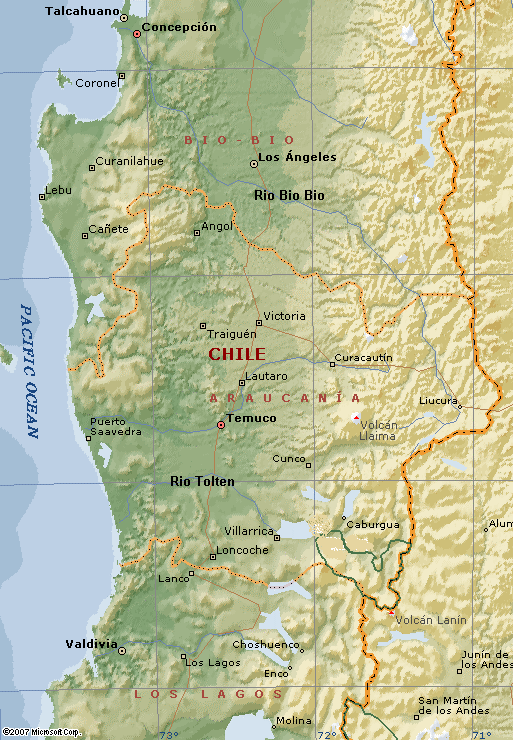
Araucania (click to enlarge)


When the Spanish arrived, the Mapuche, the indigenous people of south central Chile, were a riverine people dependant on hunting, fishing, collecting wild foods and cultivating maize, potatoes, and other American crops. Their homeland, the Araucania, from the Rio Bio Bio south to the Rio Tolten and beyond, has a temperate oceanic climate; marginal for most Amerindian crops with tropical origins, except potatoes. Average summer temperatures are in the 60s and 70s, and winter lows are usually above freezing. Annual rainfall, concentrated in the winter months, ranges from 45 inches in Temuco to almost 100 inches in Valdivia.  Not great for maize or common beans, but ideal for favas.


When fava beans were adopted by the Mapuche is unclear, but they were probably introduced to the region by the Spanish who briefly set up fortified towns in the Araucaria in the 1550s, before the Mapuche developed military tactics to drive them out.  Tomás Guevara, in El Pueblo Mapuche (The Mapuche People), writes:

With the Spanish occupation, especially in the final third of the 16th century, Araucanian agriculture underwent a major change, and in consequence, produced a revolution in the economic and social order, building on the family structure and the intelligence and energy of the patriarchal community. Without abandoning their existing crops, they learned to cultivate the cereals imported by the conquistadores, especially wheat, which they called cachilla for its origin in Castile, and barley, cahuella. Following these in importance came fava beans and peas.[4] 

Habas aren’t mentioned by Francisco Núñez de Pineda y Bascuñán, the Chilean born Spanish soldier captured by the Mapuche in 1620, who gives us some of the earliest information on Mapuche food, but they occur in virtually all later accounts of Mapuche food or agriculture.  For example, in the Mapuche lonco (headman) Pascual Coña recalled:

When I was still little I helped my father.  He worked in the fields, where he planted a little wheat, a little barley, peas, flax, maize, fava beans, common beans, potatoes; but only a little of each species; the old people had little practice in this work.  When harvest time came, all these products were gathered, but soon they ran out and a great shortage of food followed. The first foods after the great shortage (of September to November) were fava beans and peas. 
As the little harvest drew near and green products appeared, the women would go to harvest their fava beans or peas; carrying baskets and chaihues [sifting baskets]. They filled them and then returned happily to their houses.  In their houses they shelled them and put them over the fire in a large pot to boil. When they were well cooked they took the pot off the fire and put them in a big sieve. They ate them communally with soup.[5]

Today fava beans continue to be popular in Chile and in terms of area planted, are the 14th most important vegetable.  Production of 21,000 metric tons of fresh favas makes Chile the 13th largest producer in the world (2005), and among the largest exporters:  921 tons with a value of $1.6 million US. In 2008. [6]

But enough history; how and why should you try them? 

For the “why,” it’s simple:  they are good, nutritious (see below), and along with peas and asparagus, are among the earliest spring crops to appear.  They are buttery, mildly bitter, with a nutty taste.  And they are inexpensive (here in Chile), easy to grow and simple to prepare.  How? Simply snap off the ends of the long pods and string them, like big string beans.  Then open the pods and strip out the beans.


Put in a pan with a little water and steam for 5 to 8 minutes—until tender. (old beans may take longer). Taste one.  If you like it, you are done.  If you find the outer coating of the seed tough or chewy, remove it—this seems to be recommended in most recipes (here for example), but I’ve never found it necessary. 


From this point, peeled or unpeeled, there are lots of choices.   My favorite is simply seasoned with lemon juice, olive oil, spring onions, parsley, salt and pepper.


Or if they are especially young and tender, try a Spanish style 


Ingredients for an tortilla for 2 people
500 gr. fresh beans, 2 green onions, 100 cc. olive oil, salt, 4 eggs.
Procedure 

Thoroughly wash beans and pods, we will use the pods. Drain and cut the ends of each pod. No need to remove the filaments from the edges, unless the beans are not tender. Cut into pieces an inch long.
Cut the green onions into thin slices. Sauté beans in olive oil with onions over medium heat, stirring frequently, for 5 minutes. Add a glass of water, just enough to cover the beans, and a little salt, and let cook over medium heat 20 minutes, stirring occasionally, or until beans are tender and  almost all the water has evaporated.
Beat eggs separately with a little salt. Drain the beans and onions to a colander to remove excess liquid and add the beaten eggs. Pour into a medium nonstick skillet, heated with a tablespoon of olive oil. Let tortilla set over medium heat 2-3 minutes, then lower the heat and let simmer 8-10 minutes.
With the help of a plate or lid, turn the tortilla and finish cooking on the other side about 5 minutes. If you want it browned, increase the heat at the end.  The tortilla should be slightly moist inside, but that’s a matter of taste. Serve warm or at room temperature, accompanied by fresh bread.  (my translation)


Peas (Pisum sativum)

Pease porridge hot, pease porridge cold,
Pease porridge in the pot, nine days old;
Some like it hot, some like it cold,
Some like it in the pot, nine days old. [7]

Like fava beans, peas (arvejas in Chilean Spanish, guisantes [8] or chicharos elsewhere) are an old crop, cultivated in Bronze Age villages in Switzerland as early as 3,000 BC.  And like favas, they are a cool weather crop.  While today’s peas are usually eaten as green peas while tender, sweet and  young, mature dry peas were an historically important source of protein in the diet of Mediterranean, North African and European people.
A large kettle containing a thick porridge made of peas hung over the fire in many English and Scottish homes during the Middle Ages and was customary even in the sixteenth and seventeenth centuries. Because few of the peasants could afford meat, they based their meals on pease porridge with an abundance of whatever vegetables were on hand. When the fire died down at night, the morning porridge was quite cold. Each day the fire was relit, and more peas and vegetables were added to the kettle. Indeed, the original ingredients in the kettle could have been nine days old.[9]
The date of their arrival in Chile is unknown, but Juan Ignacio Molino’s Ensayo sobre la historia natural de Chile, published in 1810 notes that they were common by then:  “Garbanzos, lentils, peas, barley and other similar grains are found here in great quantities.”[10]  And the cool rainy climate of south central Chile is ideal for their cultivation.

Arvejas secas – Dry peas

Today dry peas, or field peas, continue to be produced in Chile, but at a very reduced level; production has declined from 20,000 hectares in 1930, when peas were second only to beans in hectares of legumes planted, to only about 1,800 in the late 1990’s, the last period for which I could find information.  The recent decline has been largely due to weevils that infest the dry seeds.[11]  I found mine in a tostaduria in Santiago’s large public market, La Vega.


Arvejas con arroz – peas with rice
Why was I looking for them?  Because I had eaten cordero arvajado, lamb stew with dry peas, on an ethno-tourism visit to a Mapuche home and because I knew that historically peas had been an important Chilean food.  The classic Chilean cookbook La Gran Cocina Chilena (8th Edition, 2000) includes recipes with “peas” (arvejas or guisantes) in the tile for arvejadas (stews with peas) of chicken, pigeon, lamb, tongue, meatballs, schnitzel, tripe, and conger; plus “guisantes” of Brussels sprouts and “guisante frances;” arvejas with ham and eggs, with rice, with pasta, with mote, with almonds, with leg of lamb, and with pork kidneys; tortilla de arvejas; and pea soup.  And of course, peas are in many more dishes that don’t have them in the title.  Most now call for canned or fresh green peas, but they were made originally with dry peas.

Pollo arvejada – Chicken with (green) peas

Cooking dry peas

Sort through the peas for any that seem damaged or spoiled and for any pebbles or twigs.  Then wash and cover with abundant water and soak over night.  Cook the soaked peas in their soaking water (or fresh if you prefer) until tender, 1 to 2 hours (and perhaps more), adding onions, garlic, bacon, etc. when they are ½ cooked if you wish.

(Note that whole dry peas are not the same as split peas.  Split peas are dry peas that have been skinned and mechanically split into halves.  They do not require soaking.)

Making arvejadas

Although the recipes differ in certain respects, arvejadas generally entail braising the meat with onions, garlic and perhaps other vegetables (carrots, potatoes, tomatoes) and adding fresh, canned, or cooked dry peas near the end of cooking.

Roberto Marin’s Secrets of Chilean Cuisine gives this recipe:

Pollo Arvejado
6 chicken thighs
6 medium potatoes, peeled and diced
2 carrots, sliced
3 cups fresh or frozen peas [or cooked dry peas]
1 medium onion, diced
½ cup oil
3 whole garlic cloves, peeled
1 teaspoon thyme
Salt and pepper
1.  Heat the oil in a skilled and sauté the garlic until very well browned.  Remove the garlic and fry the chicken thighs in the same oil until golden.
2. Add the carrots and onions.  When the onion is translucent, add 1½ cups water and the seasonings.  Simmer over low heat until the chicken is tender, about 30 minutes. 
3.  Add the potatoes, turn up the heat and boil for about 15 minutes.  Finally add the peas and cook another 10 minutes.
Secret:  Bring out the flavor of the chicken by marinating it for two hours before cooking using ½ clove of crushed garlic, thyme, a tablespoon of lemon juice, and salt and pepper.

********************
Nutritionally fava beans and peas are similar, providing good levels of protein with very little fat, useful quantities of iron and calcium.  They are good sources of vitamins while green, and the mature seeds are good sources of dietary fiber.[12]


[1] Gay, Claudio. 1882. Agricultura, Vol. 1 p. 160. París: En casa del autor; Chile: Museo de Historia Natural de Santiago. On line at http://www.memoriachilena.cl//temas/documentodetalle.asp?id=MC0002687 All translations mine unless otherwise noted.
[2] G6PDH is the most common human enzyme defect, being present in more than 400 million people worldwide. African, Middle Eastern and South Asian people are affected the most along with those who are mixed with any of the above. A side effect of this disease is that it confers protection against malaria, in particular the form of malaria caused by Plasmodium falciparum, the most deadly form of malaria. A similar relationship exists between malaria and sickle-cell disease. One theory to explain this is that cells infected with the Plasmodium parasite are cleared more rapidly by the spleen. This phenomenon might give G6PDH deficiency carriers an evolutionary advantage by increasing their fitness in malarial endemic environments.   G6PD deficiency is closely linked to favism, a disorder characterized by a hemolytic reaction to consumption of broad beans, with a name derived from the Italian name of the broad bean (fava).   Glucose-6-phosphate dehydrogenase deficiency, From Wikipedia, the free encyclopedia on line at http://en.wikipedia.org/wiki/Glucose-6-phosphate_dehydrogenase_deficiency
[3] Posts tagged “growing fava beans” Botanical Interests Online, On line at http://www.botanicalinterests.com/blog/?tag=growing-fava-beans and Vicia faba
From Wikipedia, the free encyclopedia.  On line at http://en.wikipedia.org/wiki/Vicia_faba
[4] Guevara, Tomás.  2003. El Pueblo Mapuche. Chapt. 4.  On line at http://www.cervantesvirtual.com/servlet/SirveObras/12826627559064844198624/index.htm
[5] Wilhelm de Moesbach, Ernesto. 1936 Vida y costumbres de los  indigenas araucanas  en  la segunda mitad del siglo xix (presentadas en la autobiografia  del  indigena  Pascual Coña). Santiago de Chile: Imprenta Universitario Estado 63. p. 31 & 96.On line at http://www.memoriachilena.cl//temas/documento_detalle.asp?id=MC0008879
[6] Chilean Agriculture Overview, 2009. Agarian Policies and Studies Bureau, Ministerio de Agricultura. On line at www.odepa.gob.cl/odepaweb/publicaciones/Panorama2009.pdfHabas 'baby' buscan diversificar mercado de las hortalizas, 4/7/2008. Chile Potencia Alimentaria on line at http://www.chilepotenciaalimentaria.cl/content/view/225483/Habas-baby-buscan-diversificar-mercado-de-las-hortalizas.html#content-top , and El cultivo de la haba, InfoAgro.com, on line at http://www.infoagro.com/hortalizas/haba.htm.
[7] Children’s song of unknown origin, see “Pease Porridge Hot” From Wikipedia, the free encyclopedia, on line at http://en.wikipedia.org/wiki/Pease_Porridge_Hot
[8] “Guiso” is “stew” in Spanish; “guisante” is “pea.” Although it seems to mean “that which is stewed” it turns out to be from the Arabic biššáut, "pea."  Evidently the two are unrelated.
[9] Pease Porridge Hot, Pease Porridge Cold, Vegetarians in Paradise, on line at http://www.vegparadise.com/highestperch52.html
[10] Molina, Juan Ignacio.  1987. Ensayo sobre la historia natural de Chile: Bolonia 1810. Primera traducción del original italiano, prólogo y notas del Prof. Dr. Rodolfo Jaramillo.  Santiago :  Eds. Maule. p. 198. On line at http://www.memoriachilena.cl/temas/documentodetalle.asp?id=MC0002868, and Chilean Agriculture Overview, op. cit.
[11] Correa Vergara, Luis. 1938. Agricultura Chilena. Vol. 1. Santiago:  Imprenta Nascimiento. p. 138.  On line at http://www.memoriachilena.cl/temas/documento_detalle.asp?id=MC0027745