Showing posts with label vegetables. Show all posts

Saturday, April 30, 2011

Vegetarian Chile

If you arrived here in search of that North American favorite, vegetarian chili, you have misgoogled; this is about vegetarian food in Chile. But it might be worth reading further; Chile has an extensive repertory of meatless dishes that fed the upper classes on meatless Fridays and the poor all year round.
The food of the country people is very simple….  most of the time eating vegetables and above all potatoes, beans, peas, wheat and corn boiled like rice or as toasted flour, and on rare cases meat, preferring to sell the animals they raise and never lack.  When it is the hacienda owner who feeds them, they seem to still be in the middle ages for the great uniformity of their food, because it is made up of only a single plate of beans in the north and peas in the south, simply cooked in water or seasoned with a little fat or pork cracklings. This is the diet of all year round, which they prefer and request, feeling that it makes them strong and long suffering for their work, which the results seem to confirm.[1]
Whether the Chilean peasantry’s diet was largely meatless by choice, as Claudio Gay’s 1860s work suggests, or through poverty, as is more likely (note that food for festivals and weddings was not meatless) they developed a large variety of meatless dishes, some now classics of Chile’s Creole cuisine.

The food of the indigenous Mapuche, which blended with colonial Spanish cooking to produce Creole cuisine, was based on maize, potatoes, common and lima beans, squash, and quinoa, along with the meat of domesticated llamas and wild game, fish and shellfish.  Some of today’s popular meatless dishes are direct descendants of Mapuche foods:


Humitas, Chilean tamales (and incidentally the subject of the first post in “Eating Chilean”) continue to be among the 10 most popular Chilean home cooked foods.[2] The original Mapuche humitas were made solely of maize (corn) picked while still in the milky stage, but today’s humitas also include lard, onion and basil, though a vegetarian or vegan version is a simple modification of the recipe in the link above.


Porotos Granados, shell beans cooked with corn and squash, are also among Chileans’ top ten home cooked meals.  Cranberry beans are boiled with a bit of onion.  When within 30 minutes or so of being done, winter squash (zapallo) is added, and when it has cooked soft,  corn cut from the cob is added and cooked for an additional 10 minutes until the stew is thick.  For a more detailed and illustrated recipe, take a look at this one by Chilean Gringa blogger Eileen Smith.  And for a winter version using dry beans and spagetti, there is Porotos con riendas (beans with reins).

Tomatican, another Chilean Creole dish with indigenous origins, is a stew of tomatoes, corn, and onions, which may include meat, lima beans or cochayuyo, eatable kelp. Vegetarian versions are common and have entered the international repertory of meatless dishes.  Here is a recipe from Mooswood Restaurant Cooks at Home.  The version with cochauyo seems not to be available elsewhere in English, so here’s one adapted from Recetas de Cocina.


          Bundled...             and packaged cochayuyo

Incidentally cochayuyo is an excelent addition to meatless cooking of all kinds. types.  In Chile it replaces meat in dishes ranging from stews and soups to pastas to empanadas.  There are several more recipies in English at Seaweed: Cochayuyo and Luche.  It is occasionally available by mail in the US at Amigo Foods or Tu Chile Aquí and in Europe at Cresta Ecologia


Vegetarianism as a movement, which began in England in 1847[3], seems to have arrived in Chile in the late 19th century, along with many other European influences.  Der Vegetarier for June 15, 1891:  “Herr Rudolf Franck describes the progress of Vegetarianism in Chili. Though the Valparaiso Society numbers only 12 members, it possesses a library and reading room, but, as yet, no restaurant. The chief reason for this want is the difficulty in finding a manager.”   Three years later “the Valparaiso Vegetarian Society, which was founded in 1889, now counts 25 members, mostly Germans...” [4]


By the 1930s, there were evidently enough Chilean vegetarians to support publication of a cook book, the 1931 Manual of Chilean Vegetarian Cuisine, [5] which, along with many French, Spanish and Italian recipes (pastas, tortillas, vegetable pies and puddings) includes a variety of clearly Chilean dishes: pancurtas (dumplings or noodles for soup), maize chupe (chupes are milk based stews), humitas, stewed hominy, cochayuyo “meatballs,” cochayuyo pudding, fried cochayuyo, stuffed cochayuyo, etc.


Her recipe for Stewed Hominy (mote de maiz guisado) is as follows: 
First pass the maize kernels through clear lye, and when the husks are loose, remove them and boil until cooked, then grind in the machine [food mill], fry in vegetable shortening with a little minced onion and parsley and lighten with milk. To serve, top with two egg yokes, grated cheese and cream, and surround with fried potatoes.

Among those Chilean vegetarians of the 1930s the most famous today is Manuel Lezaeta Acharán, author of La Medicina Natural al Alcance de Todos [6] (Natural Medicine in Reach of Everyone), which by 1989 had been published in 148 editions around the world and was the most-read book of natural medicine in Latin America.


Born in 1881, he entered the University of Chile medical school in 1899, but was forced to drop out because of syphilis and gonorrhea, then incurable. After unsuccessful treatment by numerous conventional physicians, he met German priest and practitioner of hydrotherapy and diet therapy Tadeo de Wiesent, who returned him to health in a few months. Thereafter, completely disillusioned with conventional medicine, he devoted his life to study and practice of natural medicine. He became an attorney and Professor of Spanish and History at the Santiago Institute of Humanities, and traveled through out the Americas promoting his Thermal Doctrine of the Science of Health. [7]


His ten rules for health are:
Breathe pure air.  Eat exclusively natural products.  Be sober constantly.  Only drink plain water.  Be very clean in every way.  Dominate the passions, seeking greater chastity.  Never be idle.  Rest and sleep only as necessary.  Dress simply and with ease, and Cultivate all the virtues, trying to always be happy.

Lezaeta Acharán’s dietary philosophy is based on what he considers to be natural law:

The natural order establishes that the mineral kingdom sustains the vegetal and the vegetal sustains he animal, from which results that ingestion of mineral substances, as are almost all pharmaceutical products, is to introduce extraneous materials into the organism that should not be assimilated and thus need to be eliminated. (p. 7)

Knowledgeable persons… have demonstrated without a doubt, that man is fructivorous that is, that his organism is constituted to feed itself on fruits.  Darwin, Lamark, Haecke, etc. have confirmed that the physiological analog of the man is the fructivorous ape.  (p. 8)

The meat of animals has not been destined to feed man and, more than food, it is a stimulant owing to the toxins that it possesses, among which are creatine, creatinine, cadaverin, etc., which injected into a rabbit in small quantities cause its sudden death. (p. 8)

Many think that a fruit diet is insufficient because shortly after having eaten they feel the need to eat again.  On the other hand a plate of meat or beans or “satisfies” the person for several hours. This is explained because fruits and seeds are digested and assimilated easily without leaving unhealthy residues.  In contrast a piece of meat or a plate of beans require an extended effort that makes the individual feel full for the four hours or more required for digestion, or better said, for “indigestion.” (p. 98)

The diet he recommends is based on fruits, seeds, leaves and roots, and includes limited amounts of whole grain bread, soft cheeses, hard cooked eggs, honey, milk, olives and even wine, but meats, fish and legumes (beans, lentils, etc.) are to be avoided:
Breakfast:  Only raw fruits in season or dry if fresh are not available. Lacking this, a plate of raw oatmeal soaked in water for 20 minutes or more, and sweetened with honey or raisins, figs or bananas. 
Dinner at mid day:  Freely if hungry, preferring salads with olives or chopped hard cooked egg, vegetables in season with nuts, omelets of vegetables mixed with egg, fresh cheese [quesillo] or raw sugar; a little bread is possible if it is whole grain or toasted.  Avoid lunch meats, fried foods, and condiments such as pepper or mustard.
Supper:  If hungry one may eat as in mid day, but in smaller quantities.  Generally a salad or a bit of raw fruit will be sufficient.  Eat slowly and deliberately to generate abundant saliva. Avoid sweets, conserves, milk, aged cheese, soft cooked eggs, and meat broths.  Don’t smoke. (p. 181)


Lezaeta Acharán’s teachings continue to be followed in Latin America and Santiago’s Villa de Vida Natural [8] includes a spa, hotel and restaurant with reasonable prices for meals and stays of one to 10 days.  Other Villas exist in Venezuela, Colombia, Mexico, and perhaps elsewhere. 

In spite of Lezaeta Acharán’s fame, vegetarians remain a distinct minority in Chile, where annual per capita meat consumption is now over 81 kg. (just under ½ lb. per day), but meatless meals continue to be a regular part of many households’ diets.  Recipes in the most recent (April, 2011) edition of Chile’s major food magazine, Paula Cocina are almost all meatless (presumably for Lent), and my wife’s family has always had occasional meatless dinners; usually once a week or more. 

Our most popular meatless dishes are tortillas, Spanish style omelets, and vegetable tarts or pies; both of which I learned from my wife.

Tortilla Española

Tortillas are literally “little cakes” a term the Spanish applied to the Mexican maize bread, the Aztecs called taxcal, and to little breads or cakes most everywhere.  But this tortilla is a mixture of eggs and vegetables (sometimes meats are added) eaten as a main course or cut into small pieces as appetizers or tapas. Serve hot or at room temperature.

The classic Spanish tortilla contains potatoes and onions, but an infinity of tortilla varieties are popular in Spain and in here in Chile as well.

The basic procedure is to precook the vegetables, season with salt and pepper, mix with beaten eggs and allow to soak for a few minutes.  The mixture is then poured into a hot, well-oiled skilled and cooked slowly until about ¾ set.  The tortilla is then turned over (here’s how) and cooked a few minutes more, until the center is set but still moist.

Tortilla de porotos verdes (green beans)

The classic Spanish tortilla of potatoes and onions calls for the vegetables to be simmered in olive oil until cooked, but not brown, then drained and added to the eggs.  For a slightly less caloric version parboil the thinly sliced potatoes for a few minutes instead of frying.  Green beans, another family favorite, are also best parboiled, as are broccoli, cauliflower, etc., but spinach, zucchini, chard, peppers, mushrooms, tomatoes, eggplant, etc. are best sautéed in olive oil along with a few sliced onions.  Very wet vegetables like spinach, chard, tomatoes and zucchini should be drained or squeezed to remove most of their liquids.  A tablespoon or two of flour added to the eggs is also a good idea with many fillings to prevent watery tortillas.  And while not traditional, cheese also makes a good addition.

Some of our favorites are spinach and onion, French cut green beans with mushrooms, sliced zucchini with red bell peppers, potatoes with bell peppers, caramelized onions, and so on.  And of course a tortilla is a great way to use leftovers.  Do you have leftover rice, Brussels sprouts and winter squash?  Make a tortilla.

Another favorite is a vegetable pie, a pastel de verduras, like my wife’s green bean, onion and mushroom tart below.


The procedure is to make a pie crust, then parboil the beans and sauté the mushrooms and onions.  Mix with blanched green beans and moisten with cream (½ cup or so), fill the crust and top with a lattice of pie dough.  Bake in a moderate oven until the crust is brown.  Spinach or chard also makes a good filling.    


Vegetarian restaurants and products

Santiago is not Portland (said be the US’s most veggie friendly city), but there are a few vegetarian restaurants; tofu, quinoa, textured soy protein, and a wide variety of grains and legumes are available if you know were to look; and there are fresh fruits and vegetables in great variety and low cost in ferias, “farmer’s markets."  On the other hand, non-vegetarian restaurants (except Chinese restaurants) seldom have main dishes without meat or seafood, and most shortening and margarines contain fish or animal fats, so breads and pastries are suspect. 

Links:

The Vegetarian Endeavor in Santiago” in Revolver Magazine has restaurant reviews.

Reinaldo’s blog: Tiendas de comidas vegetarianas (Stores with vegetarian foods)

Cocina del mercado A blog on vegetarian cooking and recipes by the chef/owner of one of Santiago’s best known Vegetarian restaurants—in Spanish.

Chile Forum:  Food in Chile. An English language forum with a search function where you can search for (and find!) where to buy tofu, soy milk, etc.


[1] Gay, Claudio. 1862-1865.  Agricultura, Tomo 2. París: En casa del autor; Chile: Museo de Historia Natural de Santiago, p. 161. On line at http://www.memoriachilena.cl/temas/documentodetalle.asp?id=MC0002688
[2] Terra, Blog Gouyr.net.  El Terremoto se quedó con el premio Bicentenario.  2010-03-26.  On line at http://www.terra.cl/gournet/index.cfm?pagina=blog_comentario&idpost=16733&idblog=16&titulo_url=El_Terremoto_se_quedo_con_el_premio_Bicentenario
[3]  The Modern Vegetarian Movement. How Vegetarians Work. On line at http://recipes.howstuffworks.com/vegetarian2.htm
[4] History of Chile Vegetarian Societies, international Vegetarian Union on line at http://www.ivu.org/history/societies/chile.html
[5] Vergara Díaz, Lucía. 1  931. Manual de cocina vegetariana chilena. Santiago: Impr. Gutenberg, selected chapters on line at http://www.memoriachilena.cl//temas/dest.asp?id=manualdecocinavegetarianachilena
[6] Lezaeta Acharan, Manuel. 1997.  Medicina natural al alcance de todos, 2nd Edition.  Mexico, D.F.: Editorial Pax.  On line at Google books
[7] Manuel Lezaeta Acharán. Wikipedia Español.  On line at http://es.wikipedia.org/wiki/Manuel_Lezaeta_Achar%C3%A1n
[8] Villa De Vida Natural “Manuel Lezaeta Acharan”, Tomas Moro 261, Las Condes. Telefonos 716 3250

Friday, October 22, 2010

Broad Beans and Peas


Cultivation of vegetables in Chile maintains a geographic distribution according to the taste of the inhabitants, or more accurately, according to the nature of the climate.  In the north beans are dominant, in the south peas, among the Mapuche fava beans and in the archipelago of Chiloé, potatoes. Caludio Gay 1882 [1]

Most of the posts in Eating Chilean start out with something new I see in the market, and this is no exception.  I had never seen, much less eaten, fava beans in the US, but knew about them because of their relation to favism, a genetic intolerance discussed in every introductory course in Physical Anthropology. [2] Peas, of course, I knew.  But only the fresh green ones; finding dried peas—as in pease porridge hot—to be common in Chile (historically, if not today) was another surprise.   

Broad Beans or Fava Beans (Vicia faba)

Broad beans (habas in Spanish) are among the world’s oldest domesticated plants, and were part of the Mediterranean crop inventory by 6000 BC or earlier. 

As a dry bean—and apart from garbanzos the only bean known in Europe--they were commonly part of ship’s stores, and probably came to the Americas with Columbus and to Chile with the conquistadores.  While they are very hardy and can be grown under a wide variety of conditions, they do best in cool climates and do not set seed pods well in temperatures over 65° F.[3]

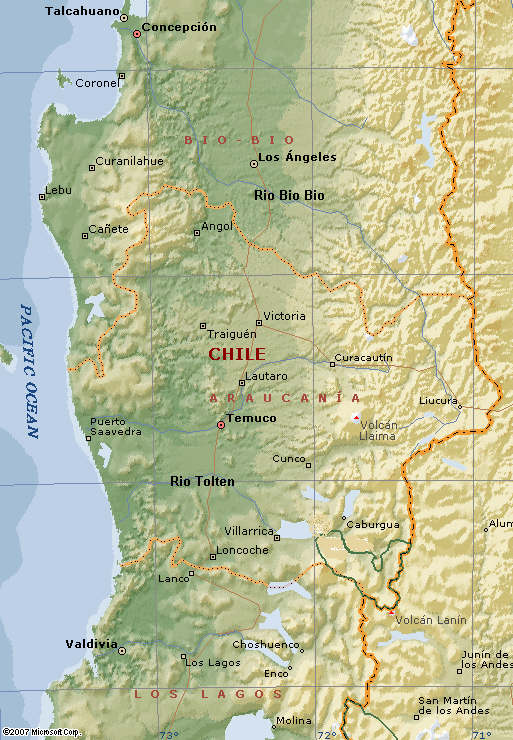
Araucania (click to enlarge)


When the Spanish arrived, the Mapuche, the indigenous people of south central Chile, were a riverine people dependant on hunting, fishing, collecting wild foods and cultivating maize, potatoes, and other American crops. Their homeland, the Araucania, from the Rio Bio Bio south to the Rio Tolten and beyond, has a temperate oceanic climate; marginal for most Amerindian crops with tropical origins, except potatoes. Average summer temperatures are in the 60s and 70s, and winter lows are usually above freezing. Annual rainfall, concentrated in the winter months, ranges from 45 inches in Temuco to almost 100 inches in Valdivia.  Not great for maize or common beans, but ideal for favas.


When fava beans were adopted by the Mapuche is unclear, but they were probably introduced to the region by the Spanish who briefly set up fortified towns in the Araucaria in the 1550s, before the Mapuche developed military tactics to drive them out.  Tomás Guevara, in El Pueblo Mapuche (The Mapuche People), writes:

With the Spanish occupation, especially in the final third of the 16th century, Araucanian agriculture underwent a major change, and in consequence, produced a revolution in the economic and social order, building on the family structure and the intelligence and energy of the patriarchal community. Without abandoning their existing crops, they learned to cultivate the cereals imported by the conquistadores, especially wheat, which they called cachilla for its origin in Castile, and barley, cahuella. Following these in importance came fava beans and peas.[4] 

Habas aren’t mentioned by Francisco Núñez de Pineda y Bascuñán, the Chilean born Spanish soldier captured by the Mapuche in 1620, who gives us some of the earliest information on Mapuche food, but they occur in virtually all later accounts of Mapuche food or agriculture.  For example, in the Mapuche lonco (headman) Pascual Coña recalled:

When I was still little I helped my father.  He worked in the fields, where he planted a little wheat, a little barley, peas, flax, maize, fava beans, common beans, potatoes; but only a little of each species; the old people had little practice in this work.  When harvest time came, all these products were gathered, but soon they ran out and a great shortage of food followed. The first foods after the great shortage (of September to November) were fava beans and peas. 
As the little harvest drew near and green products appeared, the women would go to harvest their fava beans or peas; carrying baskets and chaihues [sifting baskets]. They filled them and then returned happily to their houses.  In their houses they shelled them and put them over the fire in a large pot to boil. When they were well cooked they took the pot off the fire and put them in a big sieve. They ate them communally with soup.[5]

Today fava beans continue to be popular in Chile and in terms of area planted, are the 14th most important vegetable.  Production of 21,000 metric tons of fresh favas makes Chile the 13th largest producer in the world (2005), and among the largest exporters:  921 tons with a value of $1.6 million US. In 2008. [6]

But enough history; how and why should you try them? 

For the “why,” it’s simple:  they are good, nutritious (see below), and along with peas and asparagus, are among the earliest spring crops to appear.  They are buttery, mildly bitter, with a nutty taste.  And they are inexpensive (here in Chile), easy to grow and simple to prepare.  How? Simply snap off the ends of the long pods and string them, like big string beans.  Then open the pods and strip out the beans.


Put in a pan with a little water and steam for 5 to 8 minutes—until tender. (old beans may take longer). Taste one.  If you like it, you are done.  If you find the outer coating of the seed tough or chewy, remove it—this seems to be recommended in most recipes (here for example), but I’ve never found it necessary. 


From this point, peeled or unpeeled, there are lots of choices.   My favorite is simply seasoned with lemon juice, olive oil, spring onions, parsley, salt and pepper.


Or if they are especially young and tender, try a Spanish style 


Ingredients for an tortilla for 2 people
500 gr. fresh beans, 2 green onions, 100 cc. olive oil, salt, 4 eggs.
Procedure 

Thoroughly wash beans and pods, we will use the pods. Drain and cut the ends of each pod. No need to remove the filaments from the edges, unless the beans are not tender. Cut into pieces an inch long.
Cut the green onions into thin slices. Sauté beans in olive oil with onions over medium heat, stirring frequently, for 5 minutes. Add a glass of water, just enough to cover the beans, and a little salt, and let cook over medium heat 20 minutes, stirring occasionally, or until beans are tender and  almost all the water has evaporated.
Beat eggs separately with a little salt. Drain the beans and onions to a colander to remove excess liquid and add the beaten eggs. Pour into a medium nonstick skillet, heated with a tablespoon of olive oil. Let tortilla set over medium heat 2-3 minutes, then lower the heat and let simmer 8-10 minutes.
With the help of a plate or lid, turn the tortilla and finish cooking on the other side about 5 minutes. If you want it browned, increase the heat at the end.  The tortilla should be slightly moist inside, but that’s a matter of taste. Serve warm or at room temperature, accompanied by fresh bread.  (my translation)


Peas (Pisum sativum)

Pease porridge hot, pease porridge cold,
Pease porridge in the pot, nine days old;
Some like it hot, some like it cold,
Some like it in the pot, nine days old. [7]

Like fava beans, peas (arvejas in Chilean Spanish, guisantes [8] or chicharos elsewhere) are an old crop, cultivated in Bronze Age villages in Switzerland as early as 3,000 BC.  And like favas, they are a cool weather crop.  While today’s peas are usually eaten as green peas while tender, sweet and  young, mature dry peas were an historically important source of protein in the diet of Mediterranean, North African and European people.
A large kettle containing a thick porridge made of peas hung over the fire in many English and Scottish homes during the Middle Ages and was customary even in the sixteenth and seventeenth centuries. Because few of the peasants could afford meat, they based their meals on pease porridge with an abundance of whatever vegetables were on hand. When the fire died down at night, the morning porridge was quite cold. Each day the fire was relit, and more peas and vegetables were added to the kettle. Indeed, the original ingredients in the kettle could have been nine days old.[9]
The date of their arrival in Chile is unknown, but Juan Ignacio Molino’s Ensayo sobre la historia natural de Chile, published in 1810 notes that they were common by then:  “Garbanzos, lentils, peas, barley and other similar grains are found here in great quantities.”[10]  And the cool rainy climate of south central Chile is ideal for their cultivation.

Arvejas secas – Dry peas

Today dry peas, or field peas, continue to be produced in Chile, but at a very reduced level; production has declined from 20,000 hectares in 1930, when peas were second only to beans in hectares of legumes planted, to only about 1,800 in the late 1990’s, the last period for which I could find information.  The recent decline has been largely due to weevils that infest the dry seeds.[11]  I found mine in a tostaduria in Santiago’s large public market, La Vega.


Arvejas con arroz – peas with rice
Why was I looking for them?  Because I had eaten cordero arvajado, lamb stew with dry peas, on an ethno-tourism visit to a Mapuche home and because I knew that historically peas had been an important Chilean food.  The classic Chilean cookbook La Gran Cocina Chilena (8th Edition, 2000) includes recipes with “peas” (arvejas or guisantes) in the tile for arvejadas (stews with peas) of chicken, pigeon, lamb, tongue, meatballs, schnitzel, tripe, and conger; plus “guisantes” of Brussels sprouts and “guisante frances;” arvejas with ham and eggs, with rice, with pasta, with mote, with almonds, with leg of lamb, and with pork kidneys; tortilla de arvejas; and pea soup.  And of course, peas are in many more dishes that don’t have them in the title.  Most now call for canned or fresh green peas, but they were made originally with dry peas.

Pollo arvejada – Chicken with (green) peas

Cooking dry peas

Sort through the peas for any that seem damaged or spoiled and for any pebbles or twigs.  Then wash and cover with abundant water and soak over night.  Cook the soaked peas in their soaking water (or fresh if you prefer) until tender, 1 to 2 hours (and perhaps more), adding onions, garlic, bacon, etc. when they are ½ cooked if you wish.

(Note that whole dry peas are not the same as split peas.  Split peas are dry peas that have been skinned and mechanically split into halves.  They do not require soaking.)

Making arvejadas

Although the recipes differ in certain respects, arvejadas generally entail braising the meat with onions, garlic and perhaps other vegetables (carrots, potatoes, tomatoes) and adding fresh, canned, or cooked dry peas near the end of cooking.

Roberto Marin’s Secrets of Chilean Cuisine gives this recipe:

Pollo Arvejado
6 chicken thighs
6 medium potatoes, peeled and diced
2 carrots, sliced
3 cups fresh or frozen peas [or cooked dry peas]
1 medium onion, diced
½ cup oil
3 whole garlic cloves, peeled
1 teaspoon thyme
Salt and pepper
1.  Heat the oil in a skilled and sauté the garlic until very well browned.  Remove the garlic and fry the chicken thighs in the same oil until golden.
2. Add the carrots and onions.  When the onion is translucent, add 1½ cups water and the seasonings.  Simmer over low heat until the chicken is tender, about 30 minutes. 
3.  Add the potatoes, turn up the heat and boil for about 15 minutes.  Finally add the peas and cook another 10 minutes.
Secret:  Bring out the flavor of the chicken by marinating it for two hours before cooking using ½ clove of crushed garlic, thyme, a tablespoon of lemon juice, and salt and pepper.

********************
Nutritionally fava beans and peas are similar, providing good levels of protein with very little fat, useful quantities of iron and calcium.  They are good sources of vitamins while green, and the mature seeds are good sources of dietary fiber.[12]


[1] Gay, Claudio. 1882. Agricultura, Vol. 1 p. 160. París: En casa del autor; Chile: Museo de Historia Natural de Santiago. On line at http://www.memoriachilena.cl//temas/documentodetalle.asp?id=MC0002687 All translations mine unless otherwise noted.
[2] G6PDH is the most common human enzyme defect, being present in more than 400 million people worldwide. African, Middle Eastern and South Asian people are affected the most along with those who are mixed with any of the above. A side effect of this disease is that it confers protection against malaria, in particular the form of malaria caused by Plasmodium falciparum, the most deadly form of malaria. A similar relationship exists between malaria and sickle-cell disease. One theory to explain this is that cells infected with the Plasmodium parasite are cleared more rapidly by the spleen. This phenomenon might give G6PDH deficiency carriers an evolutionary advantage by increasing their fitness in malarial endemic environments.   G6PD deficiency is closely linked to favism, a disorder characterized by a hemolytic reaction to consumption of broad beans, with a name derived from the Italian name of the broad bean (fava).   Glucose-6-phosphate dehydrogenase deficiency, From Wikipedia, the free encyclopedia on line at http://en.wikipedia.org/wiki/Glucose-6-phosphate_dehydrogenase_deficiency
[3] Posts tagged “growing fava beans” Botanical Interests Online, On line at http://www.botanicalinterests.com/blog/?tag=growing-fava-beans and Vicia faba
From Wikipedia, the free encyclopedia.  On line at http://en.wikipedia.org/wiki/Vicia_faba
[4] Guevara, Tomás.  2003. El Pueblo Mapuche. Chapt. 4.  On line at http://www.cervantesvirtual.com/servlet/SirveObras/12826627559064844198624/index.htm
[5] Wilhelm de Moesbach, Ernesto. 1936 Vida y costumbres de los  indigenas araucanas  en  la segunda mitad del siglo xix (presentadas en la autobiografia  del  indigena  Pascual Coña). Santiago de Chile: Imprenta Universitario Estado 63. p. 31 & 96.On line at http://www.memoriachilena.cl//temas/documento_detalle.asp?id=MC0008879
[6] Chilean Agriculture Overview, 2009. Agarian Policies and Studies Bureau, Ministerio de Agricultura. On line at www.odepa.gob.cl/odepaweb/publicaciones/Panorama2009.pdfHabas 'baby' buscan diversificar mercado de las hortalizas, 4/7/2008. Chile Potencia Alimentaria on line at http://www.chilepotenciaalimentaria.cl/content/view/225483/Habas-baby-buscan-diversificar-mercado-de-las-hortalizas.html#content-top , and El cultivo de la haba, InfoAgro.com, on line at http://www.infoagro.com/hortalizas/haba.htm.
[7] Children’s song of unknown origin, see “Pease Porridge Hot” From Wikipedia, the free encyclopedia, on line at http://en.wikipedia.org/wiki/Pease_Porridge_Hot
[8] “Guiso” is “stew” in Spanish; “guisante” is “pea.” Although it seems to mean “that which is stewed” it turns out to be from the Arabic biššáut, "pea."  Evidently the two are unrelated.
[9] Pease Porridge Hot, Pease Porridge Cold, Vegetarians in Paradise, on line at http://www.vegparadise.com/highestperch52.html
[10] Molina, Juan Ignacio.  1987. Ensayo sobre la historia natural de Chile: Bolonia 1810. Primera traducción del original italiano, prólogo y notas del Prof. Dr. Rodolfo Jaramillo.  Santiago :  Eds. Maule. p. 198. On line at http://www.memoriachilena.cl/temas/documentodetalle.asp?id=MC0002868, and Chilean Agriculture Overview, op. cit.
[11] Correa Vergara, Luis. 1938. Agricultura Chilena. Vol. 1. Santiago:  Imprenta Nascimiento. p. 138.  On line at http://www.memoriachilena.cl/temas/documento_detalle.asp?id=MC0027745