Friday, January 14, 2011

Mapuche Wheat


Mapuche women harvesting wheat; unknown photographer and date.  On line at flickr

 As Alfred L. Crosby’s book The Columbian Exchange: Biological and Cultural Consequences of 1492 demonstrates, the interchange of plants, animals and diseases between the Americas and Afro-Eurasia changed the world.  American maize, potatoes, beans, cassava and sweet potatoes, adopted as staple foods from Ireland to China and Africa, led to tremendous dietary and demographic changes.  But while old world food systems were transformed by native American food plants, few indigenous American cultures adopted Old World crops as staple foods.

There are several reasons.  The reduced and disheartened American populations seldom needed new food sources; within the first 100 years after contact old world diseases combined with war and slavery killed 50 to 90% of American Indians, depending on the region. But climatic differences were also important; Amerindian population centers—Mesoamerica and the Andes--were in the tropics, areas with summer or year-round rainfall, and frequently, high altitudes.  The crops the Europeans brought were domesticated mainly in the temperate zone from Southwest Asia to the Mediterranean, with dry summers and winter rainfall.  Wheat, the Europeans’ most important crop, is not well suited to tropical America, and in spite of the conquistador’s insistence that their native workers plant it, successful production was, and is, limited to temperate areas: northern Mexico and the south western United States;  and Chile, Argentina and Uruguay.

In the north, Pueblo Indians adopted wheat and barley, but they never supplanted maize as staple crops.[1]  In Chile things were different: the indigenous Mapuche adopted and came to depend on a large number of European crops, especially wheat, along with barley, broad beans, peas, and flax.

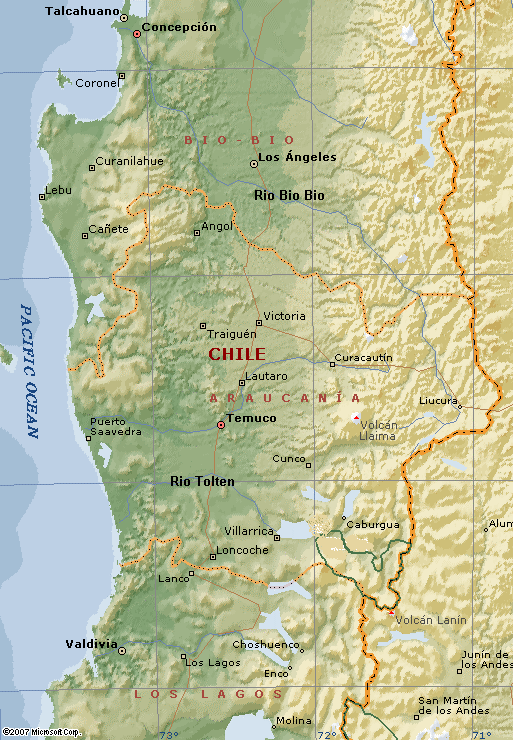
The Mapuche homeland, stretching from the Rio Bio Bio to the island of Chiloe in south central Chile (map), has a temperate oceanic climate similar to Western Europe’s.  Average summer temperatures, which decease toward the south, are in the 60s and 70s, and winter lows are usually above freezing. Rainfall is concentrated in the winter months, and increases toward the south, reaching 120 inches in the higher elevations of Chiloe Island.  Prior to the Spanish conquest, the Mapuche were a riverine people, dependant on hunting, fishing and collecting wild foods and cultivating maize, potatoes, quinoa, lima beans, chilies, and squash; all plants with tropical origins and, with the exception of potatoes and quinoa, summer crops not especially well suited to the increasingly cool and rainy climate of the south.

When the Spanish arrived, on horseback and with steel weapons fresh from the conquest of Peru, they quickly ran roughshod over the Mapuche, defeating and decimating them in battle after battle and building fortified settlements as far south as Valdivia.  They found the country to their liking.  In 1558 Jerónimo de Vivar wrote:

Wheat and barley yield very well… all the vegetables and legumes of our Spain yield very well.  And grape vines do very well, and fig trees.  And all the other plants of our Spain will yield very well, because the climate is very good. [2]

But within a generation, the Mapuche obtained horses and developed military strategies that matched and frequently surpassed those of the Spanish, and by 1600 they had destroyed the Spanish settlements, taken thousands of prisoners, and driven the Spanish north of the Rio Bio Bio, which was to be the frontier between the two peoples for the next 300 years.  In the process however, the Mapuche way of life changed drastically.  They were forced to abandon their riverside communities and take up a highly mobile way of life based on their herds of cattle and horses and shifting agriculture based largely on wheat.


In his History of the Ancient Mapuches of the South, José Bengoa, a Chilean anthropologist who has written extensively on Mapuche history, explains why: 

The war led to an economic transformation in all aspects of indigenous society. The need for mobility encouraged herding over agriculture for subsistence, and the burning of fields, commonly done by the King’s soldiers during the summer campaigns, broke the back of indigenous agriculture.  It no longer made sense to plant maize in open areas.  This was one of the reasons for the early and rapid incorporation of wheat into the indigenous economy.  In southern Chile wheat has a short productive cycle. It can be harvested in December, whereas maize is harvested in February or May, which left it highly vulnerable to summer attacks.[3]


Cultivation of wheat posed no problems from the Mapuche.  They already cultivated maize, quinoa and madi (or made, a small oil seed) and those who had been captives of the Spanish would have been familiar with wheat cultivation, as would the Mapuches’ own Spanish captives.  While there are no records of early Mapuche cultivation methods, the Spanish planted by sowing broadcast and the Mapuche probably followed the same practice.

In a shallow plowed and harrowed field the wheat is thrown on the fly, almost without covering it and leaving it at the mercy of the prodigious quantity of birds that Chile has and shortly thereafter to the invasion of weeds that this type of cultivation allows to grow freely…  [4]

Through the 19th century, the Mapuche’s harvest was by hand:

They cut the wheat with a sickle, tied the sheaves and tossed them with pitch forks into ox carts that took them to the threshing floor.[5]

And threshing was also done manually.  Juan Amasa, a Mapuche of the village of Collipulli explained:

After the harvest they would bring together 10 or 20 Indians, men and women, young and old to thresh the wheat with their feet.  The chief himself does not work, but is in charge of directing the threshing as a “corporal.”  Depending on the size of the pile of wheat the Indians go around it in lines of two to four people holding hands with their bodies inclined forward in a particular threshing step, executing two food movements with each step.  That is, the foot is put forward then drawn back, sliding the sole of his foot over the wheat, and then there is another step with the same foot, continuing the same sliding motion with the other foot and moving forward.  To the rhythm of the threshing they sing to entertain themselves in this monotonous work.[6]

If the amount of wheat was greater, horses were used for the threshing, a Spanish practice adopted by the Mapuche.


 Trillas   are now common summer festivals,  as pictured below at  the 2012 Trilla a Yegua Suelta (threshing with loose mares) in Aguila Sur Paine.


After the straw was brushed aside, the wheat remained on the ground. To separate the wheat from the chaff, it was winnowed—thrown into the air where the lighter chaff blows away and the wheat falls to the ground or the winnowing tray.

Mapuche wheat in a winnowing basket.


 Once winnowed, the Mapuche prepared wheat for consumption in several ways, most derived from tways that they had traditionally processed maize: 

Toasted flour: mürke (harina tostada)

Toasted flour was one of the most important Mapuche wheat products, adapted from the aboriginal toasted corn meal—an indigenous American Indian food from New England to Chile.  North America settlers called it “parched corn”[7], in Mesoamerica it is known as pinole, in NW Argentina it is ñaco, and in Chile mürke

The “happy captive,” Francisco Núñez de Pineda y Bascuñán who was a prisoner of the Mapuche during the 1620s and who provides one of the earliest accounts of Mapuche food, mentions “toasted flour” (harina tostada) seven times, once specifically to toasted maize flour “mixed with quinoa and made[8] although never specifically to toasted wheat flour.  (In fact, “wheat” (trigo) is only mentioned once in the text.)    

Later travelers in the Araucanía such as Edmund Reuel Smith mention toasted flour or meal frequently—and specifically to toasted wheat flour-- referring to it as a major food:

…toasted wheat and linseed ground together, of which I had already become fond, regarding the "ulpo" as not only a pleasant beverage, but almost as a necessity, in the absence of bread.[9]

José Begona describes the preparation of mürke, as follows:

The making of toasted wheat is a usually a happy family ceremony. It is a food that all apprectiate.  Earlier it was made in a clay callana, but the ones I have seen are metal.  They are like a large skillet, with a long wooden handle of a meter or more.  It is often hung from the ceiling with wire, to keep from burning oneself and to make toasting easier.  It is put over the kitchen hearth in the center of the house [and now frequently over a wood stove].  The wheat is put into the callana and stirred so that it does not burn.  A boy usually helps his mother in this task, until the wheat is well toasted and hot.  From there it is taken to the grain mill from which and perfumed smoke rises.  As it comes out of the mill it is mixed with hot water to make ulpo or allowed to cool and added to apple chicha [cider], for one of the most successful combinations of Mapuche cuisine.  The guests drink the chicha stirring the toasted flour with a spoon.  And wheat again becomes the focus of their conversations.


Traditional Mapuche milling stone


Modern hand grain mill. photo ñiyael mapuche


Toasted wheat was, and is, eaten as ulpo, mixed with cold or hot water (chercan) or was boiled in water to make a porridge.  My wife recalls having ulpo as a child, and of eating it sprinkled over watermelon.  It continues to be popular and is available in supermarkets.
Lightly toasted wheat that is coarsely ground is tukun, locro in Chilean Spanish.  It is added to soups and stews.

Peeled wheat: kako cachilla (mote de trigo)

Another indigenous American technique for preparing maize was transferred to wheat by the Mapuche: nixtamalization. In this process dry maize kernels are cooked in water containing an alkali—wood ashes, lye or lime--which causes the maize to swell and the pericarp or clear skin of the kernel to come loose.  The maize, now called nixtamal in Mexican Spanish is washed thoroughly to remove the pericarp and the alkaline taste and then is either ground to make tortillas or tamales, or cooked further to make pozole (mote in the Andes, hominy in N. American English).

This process is not thought to have extended further south than Colombia prior to the Spanish conquest, but it was part of the Mapuche culinary repertory by the 1620s when Pineda y Bascuñán was a Mapuche captive.[10]  He mentions being given mote eight times; corn mote twice and barley mote once. The rest were “mote” with no modifier.  Today in Chile unmodified “mote” means wheat mote and Chilean historian Begona believes that both toasted wheat flour and wheat mote were part of Mapuche diet by this time, although bread was not.[11]

The process of making wheat mote, as Mapuche Luisa Quidel does it for sale in Temuco is as follows:

After the wheat is harvested you must obtain ashes for processing the wheat from a local bakery.  The ashes need to be cleaned and passed through a sieve to make good wheat mote.  The mote must be cooked at a suitable temperature for the best results, so it is done over a wood fire.  It is a slow process, but gas is too expensive.  Next the water is drained off, and the mote, husks now loosened by the ashes, is peeled.  It is scrubbed by hand and this is also a sacrifice; it is tiring work and there is no one to help her. The process is finished when the mote is well washed and allowed to rest until she leaves to sell it early the next morning. [12]

Mote is eaten as a boiled grain, like rice, and in soups and stews with other products: potatoes, beans, peas.  It is also the basis for catuto or mültrun, a bread like mixture of ground mote, lard or oil, and salt which is formed into oblong rolls, and eaten as is, toasted on the coals, as below, or sautéed in a little grease[13]. (It is also made of boiled wheat that has not been peeled.)


Catutos on the coals.  photo: Pablo Azúa


Wheat beer:  mudai or muday (chicha de trigo)

In South America chicha (from chichab, “maize” in an aboriginal language of Panama) usually refers to an alcoholic beverage made of corn, but it can also refer to virtually any fermented fruit cider or even unfermented maize drinks. In modern Chile it refers to lightly fermented grape wine or, in the south, to apple cider.  Mudai, maize chicha, was traditionally made by cooking ground corn in water, adding masticated maize meal, and allowing the mixture to ferment.  The chewed meal contains enzymes from the saliva which convert the maize starch into sugar, which yeasts then convert into alcohol. (In making beer “malting” or sprouting the grain accomplishes the same purpose.)  Sometimes left over muday from a previous batch with well developed yeast was added to speed fermentation.

The Mapuche quickly adapted the same process to wheat and barley.  Edmund Reuel Smith, who came to Chile as a civilian member of the US Naval Astronomical Expedition (1849-52), traveled through Araucanía to see and learn abut the Mapuche.  He found mudai  “a kind of fermented liquor, rather muddy but not unpleasant to the taste.”  Later he saw how it was made[14]:


Today’s mudai is made without mastication, and may be drunk at any stage in the fermentation process.  Lightly fermented mudai is a refreshing, milky and slightly sour drink.  When I asked why they served the “light” variety, my host said “wincas [non Mapuches] don’t usually like the strong kind.” The recipe below comes from the web site Mapuches Urbanos:


 Other recipes add yeast and substantial quantities of sugar (replacing much of the wheat) to produce a more alcoholic beverage in less time.

Bread:  kofke

Bread was not an early addition to the Mapuche diet.  Pineda y Bascuñán mentions it only once, and then in the context of a Mapuche chief with a mestiza daughter and presumably a Spanish wife

We arrived at mid day and were received with great pleasure and regaled highly as this chief was very Spanishised [españolado] and ostentatious:  his house had many chickens, fresh meat, bacon, sausages and maize and wheat bread, and above all, a lot of chicha of different types.

He also mentions empanadas, tortillas and “fried buñuelos and rosquillas and sopaipillas of eggs,” Spanish pastries made of wheat flour, but these do not seem to have been common in Mapuche kitchens until the late 19th and 20th centuries when they could take their wheat to mills for grinding into a fine flour.

Since that time, however, bread has been a major factor in Mapuche life.  José Begona, who has referred to the Mapuche as The Wheat People, writes:
Making bread continues to be the principal activity of the Mapuche woman.  It occupies a good part of her day.  There are several customs.  Some women prefer to leave the dough over night, ready to make bread in the morning, others like to make use of the embers of the kitchen hearth and have the bread ready.  This is the “ash bread” [tortilla de rescoldo], cooked in the hot ashes of the hearth.  Sometimes it is left overnight and the next day, on getting up, the bread is ready and still hot.  Other women rise, knead and prepare the bread for breakfast. [15]

The other common Mapuche bread is the sopapilla, fried bread.  Although individual household recipes differ, the dough for the two can be the same:  Flour is mixed with salt and a piece of dough from a previous day and/or baking powder, and in some households lard, and kneaded.  It is allowed to rise, and if it is to be a tortilla de riscoldo, buried in the ashes of the hearth.  For sopapillas the dough is rolled out into a 4 or 5 inch circle and fired in oil, or preferably (according to some) in horse fat.  (For more on Mapuche sopapillas and tortillas de riscoldo, see Mapuche Food: Ethno Tourism/Ethno Gastronomy.)

Noodles: pangkutra (pantrucas)

Humble noodles of flour, water, salt and perhaps egg and oil, cooked in a meat broth were the most commonly eaten “traditional Mapuche foods” encountered in a recent survey of Mapuche dietary habits in Temuco.[16] (The next most common were tortillas de riscoldo, merkin and horse meat.)


Links:  Arte Culinaria Mapuche contains 20+ Mapuche recipes in Spanish

More posts on Mapuche food in Eating Chilean:


[1] Vlasich, James A.  2005. Pueblo Indian Agriculture.  University of New Mexico Press.  P. 27 On line at http://books.google.com/books
[2] Torrejón, Fernando and Marco Cisternas.  2002.  Alteraciones del paisaje ecológico araucano por la asimilación Mapuche de la agroganadería hispano-mediterránea (siglos XVI y XVII)  Revista Chilena de Historia Natural 75: 729-736.  On line at http://www.scielo.cl/scielo.php?pid=S0716-078X2002000400008&script=sci_abstract  All translations mine unless otherwise noted.
[3] Bengoa, José. 2003. Historia de los Antiguos Mapuches del Sur, Ed. Catalonia, Santiago de Chile. p. 302
[4] Gay, Claudio. 1862-1865.  Agricultura, Tomo 2. París: En casa del autor; Chile: Museo de Historia Natural de Santiago, p. 19. On line at http://www.memoriachilena.cl/temas/documentodetalle.asp?id=MC0002688
[5] Begona, José.  2002. Historia de un conflicto: El estado y los mapuches
en el siglo XX. 2nd Edition. p. 88. Santiago: Editorial Planeta Chilena S. A.
[6] Lenz, Rodolfo. 1895-97. Estudios Araucanos. Anales de la Universidad de Chile, Vol. 97. p. 115. On line at http://www.memoriachilena.cl//temas/documento_detalle.asp?id=MC0003440
[7] Houghton Mifflin Word Origins:parched corn. On line at http://www.answers.com/topic/parched-corn
[8] Núñez de Pineda y Bascuñán, Francisco, 1608-1680. 2001. El cautiverio feliz, Tomo dos; edición crítica de Mario Ferreccio Podestá y Raïssa Kordić  Riquelme. Santiago de Chile: Seminario de Filología Hispánica, Facultad de Filosofía y Humanidades, Universidad de Chile, p. 638. On line at  http://books.google.cl
[9] Smith, Edmund Reuel. 1855. The Araucanians; or, Notes of a Tour among the Indtia tribes of Southern ChileNew York:  Harper & brothers. p. 269 On line at http://books.google.cl
[10] How nixtamalization arrived in Chile is unknown.  The most likely alternative is that the Spanish, some of whom had been in areas where the practice was common such as Panama and Mexico, introduced it to Peru and then to Chile.  But if this is the case the absence of corn tortillas, the food most commonly made from nixtamal, in Peru and Chile is difficult to explain.
[11] Bengoa, José. 2008. Historia del Pueblo Mapuche (Siglos XIX y XX). 7th corrected Edition. Santiago: Lom Eds.
[12]Aguilera Vega, Eugenia. 2007. Mote: Gusto para unos, vida para otros.  Centro de Medios Independientes Santiago, on line athttp://santiago.indymedia.org/news/2007/06/70390.php as quoted in Eating Chilean: Mote con huesillos, Chile’s favorite summer sweet. October 19, 2009. On line at http://eatingchile.blogspot.com/2009/10/mote-con-huesillos-chiles-favorite.html
[13] Mapuche, Gente de la Tierra. Comidas. Receta de Catutos. On line at http://www4.biblioredes.cl/BiblioRed/Nosotros+en+Internet/Gente+de+mi+tierra/Comidas
[14] Smith, op. cit. p. 302 quotation and illustration
[15] Begonia 202, Chapter 7
[16] Schnettler, Berta et al.  2010 Diferencias Étnicas Y De Aculturación En El Consumo De Alimentos En La Región De La Araucania, Chile.  Rev Chil Nutr Vol. 37, Nº1, Marzo 2010

Friday, December 31, 2010

Chilean Empanadas


Roll piece of dough into a circle or rectangle, add a heaping spoon of a savory or sweet mixture, fold the dough over, seal the edges and bake in an oven or fry in oil.  What is the result?


In Chile (and most of South American) it is an empanada.


Chilean baked empanadas


Why so many names and varieties?  Practically everywhere that there was wheat--from northern Europe and north Africa to India and China and the whole world by 1700 or so--it was ground and mixed with water to make dough.  And some of that dough was filled with a mixture of meat, fish, cheese, vegetables or fruit and fried or baked. The result was tasty, portable and handy to eat out of hand.

Where and when were these filled pastries first made?  No one knows but, central Asia sometime before the 9th century AD seems like a good bet. 
Arab cookery books of the 10th and 13th Centuries refer to the pastries as sanbusak (the pronunciation still current in Egypt, Syria, & Lebanon), sanbusaq or sanbusaj, all reflecting the early medieval form of the Persian word: sanbosag. Claudia Roden (1968) quotes a poem by Ishaq ibn Ibrahim-al-Mausili (9th Century) praising the sanbusaj. [1]

And from there they surely came to Spain with the conquering Arabs, sometime after 711 AD.  Remarkably, they left us a recipe.  It is from an anonymous Andalusian cookbook, The Book of Cooking in Maghreb and Andalus in the era of Almohads, of the13th century. 
A Pie [Mukhabbazah] of Lamb
Make meatballs of lamb with all the spices and flavorings, beat them with egg white, and put into the pot a spoonful of oil, cilantro juice, a spoonful of onion juice and half a spoonful of murri [use soy sauce], and pepper, cinnamon, Chinese cinnamon [cassia], a handful of pine nuts, coriander, a little caraway and a spoonful of water.  Cook until the meatballs stiffen, and cook the sauce and boil two eggs in it, then cover [the contents of the pot with eggs and breadcrumbs] and take it out to the hearthstone [a lower heat] until [the egg layer] wrinkles.  Knead a dough with white flour, water and oil.  Prepare a crust dough of this [line a pan], and put in the meatballs and the boiled eggs, after splitting, and put all the filling inside this.  Then cover it with a sheet of dough made in the same manner.  Fasten it closed and send it to the oven until it is done. Then present it, God willing. [2]

By the 12th century, the pastries were in Christian Spain and were sufficient renowned that they were shown in statues in the cathedral of Santiago de Compostela, Galicia.


Left:
“Nobles enjoying themselves in a banquet with savory empanadas,”


Right: 
 “penitent sinners in hell… eternally condemned to the tormenting penalty of not being able to eat an empanada because of a leather halter fastened around their necks so they cannot swallow.” [3]


The Spanish added pork, as in this Pigeon Empanada from the 17th century Art of Cooking, Pastry, Cakes and Preserves by Francisco Martínez Montiño (1611), head of the kitchens of Spanish King Philip II (1527-1598):


Take four tender young pigeons from the nest and after cleaning them take some ham cut into very thin (slices?) and soak them until the salt has been removed and then squeeze out the water and season the pigeons with spices and salt and (take?) a leaf of English sweet dough for empanadas and place the pigeons on it and put the ham slices all around and close the empanada and serve hot.[4]


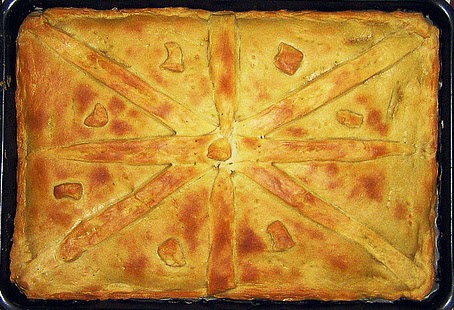
Today the empanada gallega (from Galicia) is the classic Spanish empanada and its 16th century ancestors (without tomatoes. peppers or paprika) inspired for the empanadas of Chile and other Latin American countries.  In its basic form it is a large pie (small ones are empanadillas) with a crust of flour, yeast and oil or lard; a sofrito or seasoning mixture of sautéed onion, green pepper, tomato, garlic and paprika (pimenton dulce); and a filling of pork, fish, shellfish or vegetables cooked with the sofrito. A circle or rectangle of dough is rolled out, the filling is spread on it leaving an ample border, and a top crust is applied and sealed by pressing. A hole is made in the center to let the steam escape.  Leftover dough is applied to make a design, it is painted with beaten egg, and the empanada is baked for 30 to 45 minutes in a moderate oven.

THE source for recipes is La Empanada Gallega: Everything about empanadas and Galician gastronomy”  Google provides a reasonable translation here, and there’s an authentic Galician recipe in English here.

 Empanada Gallega    photo: Maria Gonzáles 2007

In her novel Ines of My Soul Isabel Allende tells us that  empanadas arrived in Chile in 1541 with conquistador Pedro de Valdivia and his companion Inés Suárez,  and she may be right.  By the 1620s they appear to have been completely incorporated into Chile’s Creole cuisine by both Spanish and Indians:  Francisco Núñez de Pineda y Bascuñán ("the happy captive") says that he was given empanadas by his Mapuche captors in the 1620s.[5]

The classic Chilean empanada, with a pino (“filing”, from the Mapuche pinu, for pieces of cooked meat) of meat, onion, raisins, hard boiled egg and chili seems to have taken form during the colonial period and became an “indispensable national dish,"[6] but not one that got mentioned in writing very often.  Even Chile’s foreign visitors, usually a good source for information about food, seem not to have noticed them.  Only Maria Henrietta de la Cherois, in Over the Andes from the Argentine to Chile and Peru seems to have found them worthy of mention.  She describes them as “squares of thick paste filled with meat, gravy, and a suspicion of onion--Excellent!”[7]

The earliest Chilean empanada recipes I have found come from The New Kitchen Manual of 1882:[8] The recommended dough recipe reflects 19th century Chile’s abundance of, and taste for, beef fat.  As Chile’s best know culinary historian Eugenio Pereira Salas explains “what butter was for the French, and olive oil was for the Italians and Spanish, beef fat was for the Chileans.”[9] 
Take four pounds of flour, two pounds of beef lard and a pound of beef fat [grasa de vaca], melt the lard and fat and beat until fluffy before mixing with the flour.  Add six egg yokes and enough very hot water, knead for a long time and roll out many times.
Aside from the dough, the standard baked empanadas were similar to today’s, if a little plainer:
Fry minced meat, free from nerves, with a little chopped onion, fried in color [grease mixed with chili] and when the meat is done add a tablespoon of flour, mix well, and add a little water so that there will be enough juice, and leave to cool.  Make a dough with a little flour, burned fat, two eggs and brine; make the empanadas with a little of the pino inside, and bake in a good hot oven.
 But there were also empanadas “a la chilena” which were quite fancy: 
Mix a little salt, a little cinnamon, six egg yokes and an egg white in a pound of flour, half a  pound of sugar, a quarter of grease and a half cup of sweet wine.  Form a dough from all this and if it is still dry add a little milk and knead it a little.  Cut the raw meat into small pieces and fry with a little color. When the meat is cooked add onions, also fried in color, take it off the fire and add a tablespoon of raw flour; mix and season with salt, whole peppercorns, and a little sugar.  Make the empanadas and decorate the pino with raisins, olives, slices of egg, pieces of firm cooked chicken and onion, also cooked in chicken broth.  Put in the oven and when it is time to send them to the table, pour on a thick syrup mixed with ground almonds and sweetened sour cherries.

Today’s Chilean empanadas

Empanadas a an Independence Day celebration

Baked empanadas filled with beef pino are the most Chilean of foods; there is an empanadaria in every neighborhood, every food store from up-scale supermarkets to barrio groceries sells them, and they are part of every festival and public celebration.  And on Chilean Independence Day, September 18, when everyone eats empanadas, even the 33 trapped Chilean miners had specially made empanadas designed to survive the arduous trip down 700 meters through a narrow bore hole.

The recipe below is a very standard one, from a classic Chilean cookbook, La Gran Cocina Chilena [10]

Baked Chilean Empanadas
 500 gm. flour (7 cups) 
1 ½ cups warm milk
125 gm. lard melted (5/8 cups)
1 teaspoon baking powder
salt
 Make a mound of flour, salt and baking powder.  Make a well in the center of the flour and add the warm melted lard, then the milk a little at a time mixing to form a soft dough.  Knead the dough until smooth, cut into 8 pieces and roll each into a circle. 
Pino  (Filling)
 2 onions, chopped fine
½ lb / 250 gm ground beef
2 hard boiled eggs
16 olives
24 raisins
1 clove garlic, minced
Salt, pepper, parsley, oil 
Sauté the onions ground beef, garlic, chopped parsley and salt and pepper until well cooked.   Allow to cool.   Place a mound of pino on each circle of dough, add a piece of egg, 2 olives, and 3 raisins.  Fold the dough over and seal with a little egg white.  Bake until well browned.
 ************
Naturally there are other recipes, some a bit more elegant.  The one below is from La Sazón y el Gusto: Un menu en tres cidudaes de Chile  (Seasoning and Taste: Menus from three Chilean cities) as part of a menu representing Santiago.


While the classic pino of beef and onions is the most popular, many other filings abound, mostly in specialty empanada bakeries:  cheese, mushroom and cheese, olive and cheese, ham and cheese, corn and cheese, bell pepper and cheese, Roquefort, chicken and paprika, chicken and mushroom,  spinach, artichoke, Napolitana (ricotta, parmesan cheese, tomato, sausage), Salmon, shrimp, shellfish, etc.

Fried Empanadas

Fried empanadas, usually about half the size of baked, are very popular as a first course, especially in seafood restaurants where they are filled with a variety of shell fish, or with cheese; and of course with home cooks filled with cheese, pino, shellfish, or occasionally with fruit.


The dough, like that of baked empanadas, can be very rich with lard, up to a cup or more for 2 cups of flour, or relatively austere with only a tablespoon for the same amount of flour—in either case frying makes them para chupar los dedos,-- finger lickin’ good.

Here’s a recipe for Fried Cheese Empanadas with dough on the lighter side:
3 cups sifted flour
1 ½ tablespoons melted lard (60 grams)
1 cup of hot milk or water
1 teaspoon of baking powder
1 teaspoon of salt
Sliced cheese (1/3 inch / 1 cm thick)
 Mound the flour and baking powder and make a well in the center.  Add the melted lard and add the hot milk or water, stirring with a spoon.  When cool enough to handle, knead until smooth, soft, and elastic and wrap in a kitchen towel so that it remains warm.
 Roll or cut out circles (to any size you wish, usually between 4 and 8 inches/10-20 cm top with a slice of cheese (queso chanco if available), fold over and seal.  Fry in hot oil until golden.

And for shellfish empanadas, the ones in the photo above, there is an excellent illustrated recipe at Comida Chilena.  Here’s a translation: 
Fried Shellfish Empanadas 
1 kg mussels in their shells (or ½ lb / 250 gm frozen or canned shellfish, mussels, clams, machas, etc.)
1 lb / 500 gm. minced onions
Dough for 12, 4-5 inch / 10-12 cm empanadas
Steam the mussels in a little water and white wine until they open, about 2 minutes.  When cool, remove from shells and simmer with the onions and a little of the reserved steaming liquid until the onions are soft.  Fill each circle of dough with filling, leaving an ample border.  Paint the border with water or egg white, and seal.  Fry in abundant hot oil until golden.  Remove from oil and drain on paper towels.  The should be nice and juicy inside.

[1] The Samosa Connection.  On line at http://www.samosa-connection.com/origin.htm.  The book referred to is A book of Middle Eastern food.
[2] Anonymous Andalusian Cookbook: The Book of Cooking in Maghreb and Andalus in the era of Almohads, by an unknown author. Charles Perry,Translator. On line at http://italophiles.com/andalusian_cookbook.pdf
[3] Historia de la empanada. La Empanada Gallega. Text and photos on line at http://empanadagallega.fiestras.com/servlet/ContentServer?pagename=R&pubid=979757027793&c=Page&cid=1257209522972  All translations mine unless otherwise noted.
[5]  Núñez de Pineda y Bascuñán, Francisco. 1999.  El cautiverio feliz
Alicante : Biblioteca Virtual Miguel de Cervantes. Edición digital basada en la edición de Santiago de Chile, Zig-Zag, 1948. On line at  http://www.cervantesvirtual.com/obra-visor/el-cautiverio-feliz--0/html/
[6] Pereira Salas, Eugenio.  1977. Apuntes para la historia de la cocina chilena.  Santiago : Universitaria. p. 60.  On line at http://www.memoriachilena.cl/temas/documentodetalle.asp?id=MC0006512
[7] De la Cherois-Crommelin, Maria Henrietta. 1896. Over the Andes: From the Argentine to Chile and Peru.  p. 230  on line at http://www.archive.org/details/overandesfromar00cromgoog
[8]Anonymous. 1882.  Nuevo manual de cocina: conteniendo 377 recetas de guisos escojidos de las cocinas francesas, española, chilena, inglesa e italiana: arregladas para el uso de las familias del país. Valparaíso : Libr. del Mercurio de Orestes L. Tornero. Pp. 94-5  On line at http://www.memoriachilena.cl/temas/documento_detalle.asp?id=MC0003181.
[9] Pereira Salas, Eugenio. Op.Cit. p 20
[10] Alfaro, Mónica T. 2000. La Gran Cocina Chilena, 8th Edition.  Santiago:  Ediciones Occidente S.A. p. 416